How Local SEO Is Evolving with AI & Automation (2025 Guide for Businesses)

Local SEO is no longer static. Google’s Vicinity update narrowed ranking reach, while AI now shapes how local intent is understood and displayed.
AI and automation aren’t replacing SEO—they’re changing how businesses rank, optimize, and engage with customers.
This guide shows you what’s different in 2025 and gives you clear, actionable steps to adapt your local SEO strategy for lasting visibility.
Why Local SEO Has Always Been Different
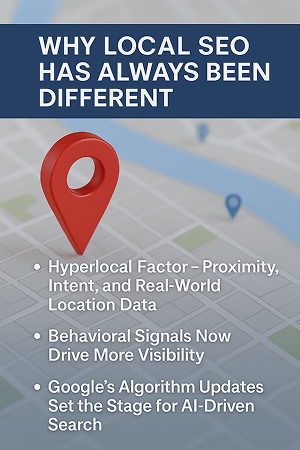
The Hyperlocal Factor – Proximity, Intent, and Real-World Location Data
Local SEO has always hinged on who’s closest and who’s relevant. No matter how polished your website is, you’ll struggle if you’re miles away from the searcher or outside their service area. Google combines literal proximity with inferred intent to decide which businesses to show first.
Behavioral Signals Now Drive More Visibility
Clicks, calls, driving-directions requests—all of these user actions matter more than ever. In fact, Google does watch clicks (among other metrics) to gauge result quality.
Google confirms watching clicks to evaluate results quality. FYI Google still won't say if clicks used as rank signal pic.twitter.com/jzNGc5reQk
— Danny Sullivan (@dannysullivan) March 25, 2015
Also, third-party data suggests GBP (Google Business Profile) signals represent as much as 33% of Map Pack ranking weight in competitive local queries.
That means even with perfect categories and address data, if users repeatedly skip your listing, Google will adjust visibility over time.
Google’s Algorithm Updates (Vicinity, Possum, Hawk) Set the Stage for AI-Driven Search
Possum (2016) filtered redundant listings, Hawk (2017) reduced suppression of nearby businesses, and Vicinity more aggressively prioritized geographic closeness. These layers tightened local relevance.
Now, Google layers AI and machine learning on top. Those updates taught Google how to penalize spammy signals and reward context, engagement, and true local authority.
In 2025, those foundations make it possible for AI to interpret relationships, sentiment, and user satisfaction—not just keywords and distances.
“Good SEO is good GEO,” says Danny Sullivan — meaning that the same core practices of relevance, clarity, and obeying user needs underpin both classic SEO and the future of generative, location-driven search.
 The Role of AI in Local Search Today
AI-Powered Google Results — SGE, AI Overviews, and Maps Pack Changes
Google’s rollout of Search Generative Experience (SGE) and AI Overviews is changing the way local results surface. Instead of just showing the familiar “3-Pack,” AI panels often summarize local businesses, reviews, and service attributes directly in search results.
That means your GBP data, reviews, and web content can now appear in the AI summary itself—not just as a blue link below it.
For local businesses, this raises the stakes. If your profile isn’t fully optimized and updated, Google’s AI may favor competitors when assembling its local summaries.
How AI Understands Local Intent Better Than Keyword Matching
Keyword stuffing is dead. AI-driven ranking models parse entities, relationships, and context to understand what a user really wants.
For example, when someone searches “best family dentist near me,” Google isn’t just looking for the words “family dentist” repeated—it’s analyzing reviews for mentions of child-friendly care, detecting local proximity, and factoring in engagement history.
According to many sources, over 60% of “near me” searches now surface results influenced by AI-interpreted attributes, not just GBP category matches. This is why filling out attributes, updating services, and maintaining review freshness all matter more in 2025.
The Rise of Conversational Search — Why Voice and Chat Queries Change the Game
Voice assistants and conversational AI are now everyday tools. Nearly 50% of U.S. adults use voice search for local needs at least once a week. Add to that the integration of Google’s Bard/Gemini into mobile search, and you have customers asking natural questions like:
- “Where’s the closest urgent care open right now?”
- “Which coffee shop in Dallas has the best Wi-Fi and parking?”
These conversational patterns mean businesses need to optimize for real, spoken language and ensure GBP fields (like hours, amenities, and attributes) are accurate and detailed. If your data isn’t complete, AI won’t surface you as a top recommendation.
Automation in Local SEO Workflows
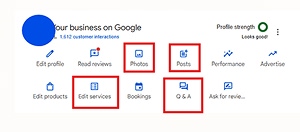 Automating GBP Optimization — Posts, Q&A, Photos, and Service Updates
Keeping your Google Business Profile active isn’t optional—it’s a signal. Automation helps you consistently publish posts, update your services, rotate photos, and prefill Q&A sections across locations. That means fewer gaps, better freshness, and reduced manual overhead.
Review Management at Scale — AI Sentiment Analysis and Auto-Reply Tools
Reviews are a local business’s lifeblood. In fact, studies show 93% of consumers say they read online reviews to influence their purchase decisions.
Moreover, 86% of consumers trust local business reviews, making reputation a trust anchor.
With AI Review tools, you can flag negative sentiment, escalate serious complaints to human agents, and auto-respond in your brand’s voice for more routine praise or feedback. That preserves reputation while scaling responsiveness.
Grid Ranking & Competitor Tracking with Automated Geo-Search Tools
Manual checks across locations or neighborhoods don’t scale. Geo-grid tools simulate searches at dozens—or hundreds—of points and generate heatmaps of your visibility.
You’ll quickly spot where competitors outrank you or where your coverage is weak. Then you can retarget content, citations, or GBP features to close those gaps.
Reporting Automation — Turning Raw Data into Client-Ready Insights Instantly
Agencies and business teams hate sifting through spreadsheets. Reporting automation connects Google Business Profile metrics (calls, direction requests, search queries), website analytics, and other local KPIs into dashboards.
You get live visualizations, alerting, and white-label reporting you can share—as soon as new data arrives.
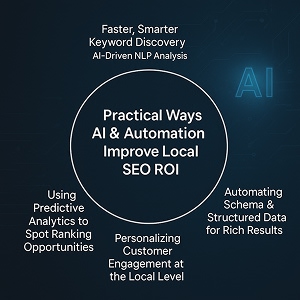 Practical Ways AI & Automation Improve Local SEO ROI
Faster, Smarter Keyword Discovery with AI-Driven NLP Analysis
Traditional keyword research often stops at volume and competition. AI-powered tools now use natural language processing (NLP) to map out how people phrase local searches in real life.
Instead of chasing just “dentist near me,” businesses can identify long-tail variations like “emergency dentist open Saturday in Dallas.”
This isn’t guesswork—AI clusters search queries, reviews, and competitor content to surface intent-driven keywords. That means content and GBP descriptions target exactly what local customers are saying, not what old keyword lists suggest.
The ROI is obvious: higher click-through rates with fewer wasted impressions.
Automating Schema & Structured Data for Rich Results
Rich snippets—star ratings, FAQs, service menus—drive higher engagement on both the SERP and in Maps. The challenge has always been implementation and upkeep.
Automation now handles schema at scale. Platforms can scan your site and GBP, then automatically generate JSON-LD markup for services, reviews, and location data.
This ensures your business is always eligible for rich results, without relying on developers to push manual updates.
Studies show businesses with structured data enjoy up to 30% higher CTR in local search results.
Using Predictive Analytics to Spot Ranking Opportunities
Instead of reacting to drops, AI models can now predict them. By analyzing competitors’ posting habits, review velocity, and ranking shifts across geo-grids, predictive analytics alerts you before your visibility dips.
For example, if a competitor ramps up reviews in a specific ZIP code, predictive tools flag the trend early, giving you time to counter with targeted campaigns.
This proactive approach converts directly into ROI—catching issues before they bleed leads and helping you allocate budget to the locations most likely to improve.
Personalizing Customer Engagement at the Local Level
Automation doesn’t just save time—it makes outreach smarter. AI can segment customer interactions by location, behavior, or even review sentiment.
That allows businesses to trigger personalized responses and offers—like sending a “10% off oil change” coupon to users who asked about wait times at your auto shop, or following up with customers who left positive reviews.
Action Plan — How To Future-Proof Your Local SEO in 2025
Step 1: Audit and Clean Up Local Listings
Start by eliminating inconsistencies. Run a full audit of your GBP, directories, and citations. Even small NAP mismatches (like “St.” vs. “Street”) can dilute trust. Google still uses consistency as a baseline signal, so clean data is your foundation.
Step 2: Integrate AI Tools for Reviews, Reporting, and Content
Don’t waste hours sorting through reviews or exporting spreadsheets. AI-driven review management surfaces sentiment patterns instantly, while reporting tools turn raw GBP and GA4 data into digestible dashboards.
Content AI can also suggest keywords, generate GBP post drafts, and highlight what’s resonating with local audiences.
Step 3: Automate Repetitive GBP and Citation Tasks
Posting weekly updates, uploading photos, refreshing service menus—these aren’t strategic decisions, they’re maintenance. Automate them.
The same applies to citation management across directories. Automation keeps your profile alive without requiring daily attention.
Step 4: Use AI to Predict Ranking Shifts and Consumer Trends
Instead of reacting after rankings tank, predictive models flag risks in advance. If a competitor suddenly accelerates review growth in a specific ZIP code, you’ll know early.
Pair that with consumer trend analysis—like identifying surging “near me” queries in your category—and you can move proactively, not reactively.
Step 5: Keep a Human Layer for Creativity, Trust, and Strategy
Automation accelerates execution, but it can’t replace human judgment. Customers know the difference between a generic auto-reply and a thoughtful response.
Strategic decisions—like positioning your brand, refining offers, or crafting storytelling—still demand human insight. AI handles scale; humans handle trust.
“Automation gets you visibility, but strategy is what keeps you chosen.” — Akmal Faizan, Founder of Stech Local
Read Also: Latest Trends in Google Map Pack Rankings in 2025
Summary
Why Local SEO Has Always Been Different
- The Hyperlocal Factor – Proximity, Intent, and Real-World Location Data: Google favors businesses closest to the searcher and most relevant to intent.
- Why Behavioral Signals Now Drive More Visibility: Clicks, calls, and engagement shape visibility alongside core ranking factors.
- How Google’s Algorithm Updates Set the Stage for AI-Driven Search: Updates like Possum, Hawk, and Vicinity prepared the ground for AI-driven context and relevance.
The Role of AI in Local Search Today
- AI-Powered Google Results — SGE, AI Overviews, and Maps Pack Changes: AI panels now summarize business info directly in search.
- How AI Understands Local Intent Better Than Keyword Matching: AI evaluates entities, reviews, and context, not just keywords.
- The Rise of Conversational Search — Why Voice and Chat Queries Change the Game: Voice and chat queries demand natural language optimization and complete GBP fields.
Automation in Local SEO Workflows
- Automating GBP Optimization — Posts, Q&A, Photos, and Service Updates
- Review Management at Scale — AI Sentiment Analysis and Auto-Reply Tools
- Grid Ranking & Competitor Tracking with Automated Geo-Search Tools
- Reporting Automation — Turning Raw Data into Client-Ready Insights Instantly
Practical Ways AI & Automation Improve Local SEO ROI
- Faster, Smarter Keyword Discovery with AI-Driven NLP Analysis
- Automating Schema & Structured Data for Rich Results
- Using Predictive Analytics to Spot Ranking Opportunities
- Personalizing Customer Engagement at the Local Level
Action Plan — How to Future-Proof Your Local SEO in 2025
- Step 1: Audit and Clean Up Local Listings
- Step 2: Integrate AI Tools for Reviews, Reporting, and Content
- Step 3: Automate Repetitive GBP and Citation Tasks
- Step 4: Use AI to Predict Ranking Shifts and Consumer Trends
- Step 5: Keep a Human Layer for Creativity, Trust, and Strategy
FAQs
How do I set up a Google Business Profile for the first time in 2025?
You’ll need a verified Google account, accurate business details (name, address, phone, website), and proof of location. Setup requires completing your profile, selecting categories, uploading photos, and passing Google’s verification process—often via video.
What is the most important factor for ranking in the Google Map Pack?
Proximity, relevance, and prominence remain core. In 2025, engagement signals—like clicks, reviews, and call activity—carry increasing weight in determining who ranks in the 3-Pack.
Does AI change how Google ranks local businesses?
Yes. AI now interprets context, reviews sentiment, and user behavior. That means complete, updated profiles with high engagement tend to outperform listings that rely only on keywords or citations.
Can automation really improve local SEO results?
Yes. Automating tasks like GBP posts, review replies, and reporting keeps your profile active and trustworthy. Consistency is rewarded, and automation ensures nothing falls through the cracks.
How do reviews impact local SEO in 2025?
Reviews influence both visibility and conversions. Google’s AI evaluates not just quantity but sentiment and recency. Fresh, positive reviews tied to services or attributes are a powerful ranking factor.
What is the difference between primary and secondary categories in GBP?
The primary category defines your main business type and has the strongest influence on ranking. Secondary categories support additional services but carry less weight.
How can AI tools help with keyword research for local SEO?
AI-driven NLP tools cluster real-world search queries, reviews, and competitor content. They uncover intent-based searches (like “best HVAC repair open now”) that traditional tools often miss.
Is voice search still important for local SEO in 2025
Yes. Nearly half of U.S. adults use voice for local queries weekly. Optimizing for conversational, long-tail phrases and ensuring GBP attributes are complete helps capture this traffic.
What mistakes cause GBP suspensions in 2025?
Common triggers include keyword-stuffed business names, listing virtual offices, inconsistent NAP data, and failing verification. Google’s AI is stricter about flagging spammy profiles.
How can I measure ROI from local SEO efforts?
Track GBP insights (calls, direction requests, website visits), review volume, engagement rates, and conversions in GA4. Automated reporting tools combine these into ROI-focused dashboards for clarity.