How To Respond To Negative Google Reviews Professionally
A one-star Google review can feel like a punch to the gut. You know potential customers are reading it, judging your business in seconds, and possibly choosing a competitor because of it.
But a negative review isn’t always a loss; it’s an opportunity. Google’s own guidelines encourage businesses to respond. Done right, a reply can not only salvage the relationship with the unhappy customer but also demonstrate professionalism to every future prospect who reads it.
If you manage your Google Business Profile (GBP) with intent, your responses will serve two purposes: protect your brand reputation and strengthen your local SEO signals.
Why Responding to Negative Google Reviews Matters
As of August 2025, Google’s own guidelines state: “When you reply to customer reviews, it shows that you value their feedback. Positive reviews and helpful replies can help your business stand out.”
Public Perception and Trust Signals
A negative review on its own doesn’t define your business—how you respond does. Prospective customers often read the owner’s replies before deciding whether to engage. A calm, respectful response shows you take feedback seriously, value customers, and are willing to address issues head-on.
Studies show that 81% of people use Google reviews when evaluating local businesses, and 88% read them before choosing one.
This is a trust signal. Even if the original reviewer never returns, every future reader sees that you handle problems professionally. For service-based businesses, that can be the deciding factor between a lost lead and a booked appointment.
Local SEO Benefits
According to studies, Reviews account for approximately 10% of local ranking factors in Google’s local pack algorithm.
Google has repeatedly stated that responding to reviews—positive or negative—helps demonstrate active engagement with your audience. This activity contributes to profile freshness, a subtle but important local ranking signal.
Approximately 75% of consumers only trust reviews written in the last 30 days, and 84% say recency is essential for trust.
When you reply promptly, you’re not just managing reputation—you’re feeding Google behavioral data that can improve visibility in the local map pack.
High-quality, personalized responses show both the algorithm and your audience that your business is attentive, real, and trustworthy, which can tip ranking outcomes in your favor over time.
Step-by-Step Framework for Responding to Negative Reviews
A bad review feels personal, but your response has to be strategic. Here’s a repeatable process that keeps emotion in check and ensures every reply works in your favor.
Step 1 – Read and Assess the Review Carefully
Before typing anything, read the review twice. Separate legitimate feedback from obvious spam or trolling. Look for specifics – dates, names, service details, that indicate a real customer experience.
If the review is vague, inflammatory, or clearly false, you may need to flag it for Google’s review policy violations instead of engaging immediately.
Step 2 – Research the Incident Internally
Once you determine the review is genuine, verify the facts. Talk to the staff involved, check your CRM or POS system for the transaction, and review any service logs or call recordings.
This step ensures your response addresses the exact situation rather than offering a generic apology. It also helps prevent misstatements that could hurt your credibility later.
Step 3 – Draft a Calm, Empathetic Response
Lead with understanding, not defensiveness. Even if you disagree with the review, acknowledge the customer’s experience.
If possible, use their first name—it personalizes the reply and shows you’re not copying and pasting templates. Keep your tone neutral and avoid anything that could escalate the situation. Your goal is to de-escalate in public and move the resolution to a private channel.
Step 4 – Post Promptly but Thoughtfully
Speed matters. Aim to reply within 24–48 hours so the reviewer and anyone else watching sees you’re responsive. That said, never sacrifice accuracy or tone for speed. A rushed, sloppy reply can make a bad situation worse.
Step 5 – Monitor for Follow-Up Engagement
Once the response is live, track whether the reviewer replies, edits their rating, or reaches out privately.
If the issue is resolved, politely ask if they’d consider updating their review. Many customers will do so when they feel heard and respected—turning a one-star hit into a four- or five-star recovery.
Real Examples of Negative Review Responses That Work
Below are real-world examples of business owners replying to negative Google reviews, along with why each response is effective in protecting reputation and maintaining trust.
Example 1 – Addressing an Unknown Reviewer
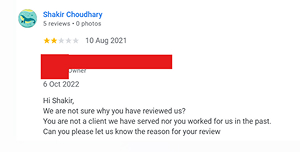
Review: The reviewer left a low rating without ever being a customer.
Response:
Hi Shakir,
We are not sure why you have reviewed us? You are not a client we have served nor have you worked for us in the past. Can you please let us know the reason for your review?
Why This Works:
- It stays calm and non-accusatory.
- It publicly clarifies for future readers that this person is not a customer.
- It invites the reviewer to explain themselves, which can lead to removal if it’s a mistaken or fake review.
Example 2 – Acknowledging and Owning Poor Interaction
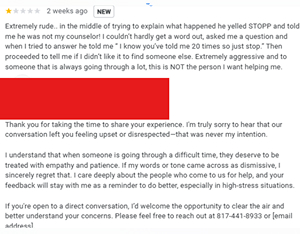
Review: The reviewer describes being interrupted and treated rudely during a stressful situation.
Response:
Thank you for taking the time to share your experience. I’m truly sorry to hear that our conversation left you feeling upset or disrespected—that was never my intention.
I understand that when someone is going through a difficult time, they deserve to be treated with empathy and patience. If my words or tone came across as dismissive, I sincerely regret that. I care deeply about the people who come to us for help, and your feedback will stay with me as a reminder to do better, especially in high-stress situations.
If you’re open to a direct conversation, I’d welcome the opportunity to clear the air and better understand your concerns. Please feel free to reach out at [phone/email].
Why This Works:
- Acknowledges the reviewer’s feelings without arguing.
- Accepts responsibility for tone and communication.
- Demonstrates self-awareness and willingness to improve.
- Moves the conversation offline to resolve privately.
Example 3 – Responding to Claims of Being Money-Driven
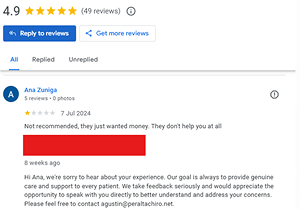
Review: The reviewer accuses the business of caring only about money.
Response:
Hi Ana, we’re sorry to hear about your experience. Our goal is always to provide genuine care and support to every patient. We take feedback seriously and would appreciate the opportunity to speak with you directly to better understand and address your concerns. Please feel free to contact [email].
Why This Works:
- Avoids defensiveness and keeps the tone neutral.
- Restates core business values (genuine care, patient support).
- Shows openness to a private discussion, signaling to other readers that feedback is taken seriously.
Example 4 – Handling a Detailed Complaint in Another Language
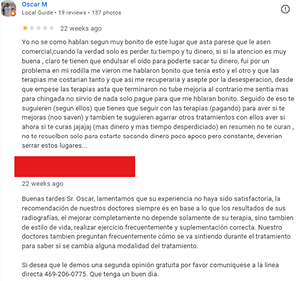
Review: A lengthy Spanish-language complaint about lack of improvement and ongoing upselling.
Response (Spanish):
Buenas tardes Sr. Oscar, lamentamos que su experiencia no haya sido satisfactoria. La recomendación de nuestros doctores siempre es en base a los resultados de sus radiografías. El mejorar completamente no depende solamente de su terapia, sino también de su estilo de vida, realizar ejercicio frecuentemente y suplementación correcta. Nuestros doctores están disponibles para evaluar nuevamente su condición y proponer una alternativa para saber si se cambia alguna modalidad del tratamiento.
Si desea una segunda opinión gratuita, por favor comuníquese a la línea [phone].
Why This Works:
- Replies in the same language as the review—respecting the reviewer’s communication preference.
- Explains the medical reasoning behind treatment recommendations.
- Offers a free second opinion, which projects confidence and goodwill.
Example 5 – Balancing Praise and Criticism in the Same Review
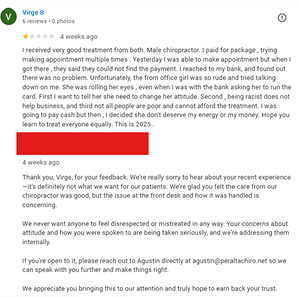
Review: Reviewer praises chiropractor’s care but criticizes front desk staff’s behavior and makes serious accusations.
Response:
Thank you, Virge, for your feedback. We’re really sorry to hear about your recent experience—it’s definitely not what we want for our patients. We’re glad you felt the care from our chiropractor was good, but the issue at the front desk and how it was handled is concerning.
We never want anyone to feel disrespected or mistreated in any way. Your concerns about attitude and how you were spoken to are being taken seriously, and we’re addressing them internally. If you’re open to it, please reach out to [email] so we can speak with you further and make things right.
Why This Works:
- Acknowledges both the positive and negative aspects of the review.
- Validates concerns without ignoring serious allegations.
- Signals to the public that the business takes internal issues seriously and acts on feedback.
Example 6 – Addressing Unprofessional Staff Behavior
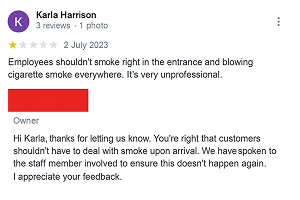
Review: The reviewer complains about employees smoking.
Response:
Hi Karla, thanks for letting us know. You’re right that customers shouldn’t have to deal with smoke upon arrival. We have spoken to the staff member involved to ensure this doesn’t happen again. I appreciate your feedback.
Why This Works:
- Directly acknowledges the problem without minimizing it.
- Validates the customer’s concern, showing alignment with their expectation of professionalism.
- States a clear corrective action (“spoken to the staff member”) so future readers know the issue was addressed.
- Keeps the tone polite and appreciative, reducing the risk of further conflict.
Example 7 – Service Complaint
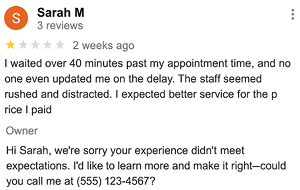
Review: The reviewer is unhappy as she has to wait despite having an appointment.
Response:
Hi Sarah, we’re sorry your experience didn’t meet expectations. I’d like to learn more and make it right—could you call me at (555) 123-4567?
Why This Works:
- Keeps the response short and focused, without debating the customer’s account.
- Shows a willingness to listen and correct the issue directly.
- Moves the resolution offline, avoiding a public back-and-forth.
- Signals to future customers that the business takes complaints seriously.
Example 8 – Product Quality Issue
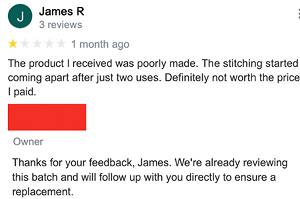
Review: James complains about the poor quality of product made.
Response:
Thanks for your feedback, James. We’re already reviewing this batch and will follow up with you directly to ensure a replacement.
Why This Works:
- Responds promptly and acknowledges the specific product issue.
- Communicates that the business is actively investigating the problem (“reviewing this batch”).
- Offers a concrete next step—a replacement—rather than a vague promise to “look into it.”
- Shows accountability to both the reviewer and future customers reading the exchange.
How To Handle Fake or Malicious Google Reviews
Fake or malicious reviews can damage your reputation just as much—sometimes more—than genuine complaints. The key is to act quickly, follow the right process, and keep a record of every step you take.
Spotting Fake Reviews
Watch for patterns that often signal a fake:
- The reviewer has no purchase or service history with your business.
- Multiple bad reviews posted on the same day for different businesses in your niche.
- Generic or irrelevant comments that don’t match your services or products.
- Repeated wording or suspiciously similar phrasing across multiple accounts.
If you can verify internally that no transaction occurred, you likely have a fake review.
Using Google’s “Flag as Inappropriate” Tool
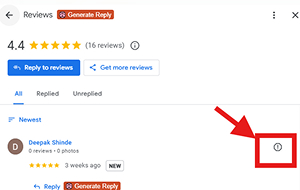
Google allows you to report reviews that violate its policies.
- Go to your Google Business Profile in Search or Maps.
- Find the review in question.
- Click the more option (!).
- Choose the reason—such as “Conflict of interest” or “Off-topic.”
Flagging doesn’t guarantee removal, but it’s the first official step.
Documenting Evidence for Disputes
If you escalate the case through Google Business Profile support or your legal team, you’ll need proof. Save:
- Screenshots of the review.
- Correspondence or lack of records proves no transaction took place.
- Any other related communications.
This documentation strengthens your case if you need to push for removal.
Legal Considerations for Defamation
If a fake review contains harmful false statements that could cause serious financial or reputational damage, it may meet the legal threshold for defamation.
- Consult a business or internet law attorney before taking legal action.
- Laws vary by state, and pursuing a defamation claim should be weighed against the potential costs and attention it may draw.
The goal is always to remove the damaging content while keeping the situation as low-profile as possible.
Golden Rules for Replying To Negative Reviews
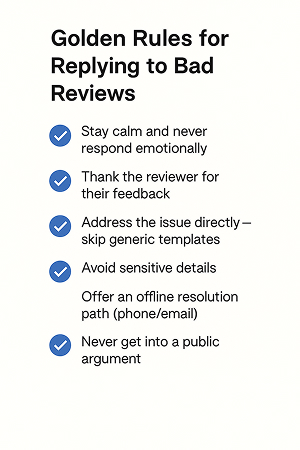
Before you start typing a response, keep these principles in mind. They’re not just about damage control—they’re about turning a public complaint into a credibility boost for your business.
1. Stay Calm and Never Respond Emotionally
A bad review can sting, especially if it feels unfair. Resist the urge to fire back or defend yourself immediately. Take a breath, step away if needed, and only respond once you can do so professionally. Your tone in a public reply is as important as the content.
2. Thank the Reviewer for Their Feedback
Even if the complaint feels exaggerated or unfounded, start by thanking the reviewer. A simple “Thank you for bringing this to our attention” shows you’re open to feedback and not dismissive of customer experiences.
3. Address the Issue Directly—Skip Generic Templates
Avoid canned phrases like “We value all feedback.” Instead, respond to the specific concern they raised. If it’s about slow service, mention how you’re working to improve wait times. If it’s about a product defect, explain the corrective steps you’re taking.
4. Avoid Sensitive Details
Never include private customer information—names, medical details, order numbers—in your public reply. Keep it general enough to protect privacy, but specific enough to show you understand the problem.
5. Offer an Offline Resolution Path
Include a phone number or email so the conversation can move to a private channel. This prevents a back-and-forth in the public space and shows others you’re proactive about resolving issues.
6. Never Get Into a Public Argument
A heated exchange in a review thread only hurts your reputation. Even if the reviewer is being unfair or hostile, maintain professionalism. Let future readers see that you handled the situation with composure.
Turning a Negative Review Into a Marketing Win
A negative review can feel like a setback, but handled well, it can become a powerful trust-builder and even a marketing asset. The key is to respond constructively, resolve the issue, and then leverage the outcome to demonstrate your business’s commitment to customers.
Follow Up After Resolution to Request Updated Reviews
Once you’ve addressed the customer’s concern—whether by replacing a product, issuing a refund, or correcting a service issue—reach back out. Politely ask if they’d consider updating their review to reflect the resolution. Many customers will, especially if the fix exceeded their expectations.
- Keep the request personal and specific, not automated.
- Remind them that their updated review can help other customers make informed decisions.
Publicly Highlight Improvements Made Based on Feedback
If a review brought attention to a recurring issue—slow service, unclear policies, product defects—use your platforms to show the changes you’ve implemented.
- Share before-and-after stories on your Google Business Profile updates, social media, or website.
- Phrase it positively: “Thanks to customer feedback, we’ve introduced a new appointment scheduling system to cut wait times in half.”
Show Future Customers That You Listen and Act
Your review responses aren’t just for the person who wrote them—they’re for every potential customer reading them later. By demonstrating transparency, accountability, and action, you send a clear message: you take customer satisfaction seriously and are willing to make things right.
Handled with skill, a bad review can actually do more to build your credibility than a dozen generic 5-star reviews. It shows you’re real, human, and committed to delivering better experiences over time.
Read Also: Tips to Get More Google Reviews
Summary
Why Responding to Negative Google Reviews Matters.
- Public Perception and Trust Signals
- Local SEO Benefits
Step-by-Step Framework for Responding to Negative Reviews
- Step 1 – Read and Assess the Review Carefully
- Step 2 – Research the Incident Internally
- Step 3 – Draft a Calm, Empathetic Response
- Step 4 – Post Promptly but Thoughtfully
- Step 5 – Monitor for Follow-Up Engagement
Real Examples of Negative Review Responses That Work
Example 1 – Addressing an Unknown Reviewer
Example 2 – Acknowledging and Owning Poor Interaction
Example 3 – Responding to Claims of Being Money-Driven
Example 4 – Handling a Detailed Complaint in Another Language
Example 5 – Balancing Praise and Criticism in the Same Review
Example 6 – Addressing Unprofessional Staff Behavior
Example 7 – Service Complaint
Example 8 – Product Quality Issue
How To Handle Fake or Malicious Google Reviews
- Spotting Fake Reviews
- Using Google’s “Flag as Inappropriate” Tool
- Documenting Evidence for Disputes
- Legal Considerations for Defamation
Golden Rules for Replying To Negative Reviews
1. Stay Calm and Never Respond Emotionally
2. Thank the Reviewer for Their Feedback
3. Address the Issue Directly—Skip Generic Templates
4. Avoid Sensitive Details
5. Offer an Offline Resolution Path
6. Never Get Into a Public Argument
Turning a Negative Review Into a Marketing Win
- Follow Up After Resolution to Request Updated Reviews
- Publicly Highlight Improvements Made Based on Feedback
- Show Future Customers That You Listen and Act
FAQs
Should I reply to every negative Google review?
Yes. Google recommends responding to all reviews—positive or negative. A reply shows potential customers that you care about feedback and are proactive in resolving issues. It can also boost engagement signals, which support local SEO visibility.
How quickly should I respond to a bad review?
Aim for within 24–48 hours. A prompt response prevents further reputational damage, shows attentiveness, and signals to Google that your profile is actively managed.
What should I avoid when replying to a negative review?
Avoid emotional or defensive language, personal attacks, and sharing sensitive customer information. Keep the tone professional, factual, and solution-oriented.
Can replying to bad reviews improve my Google ranking?
While replies alone won’t skyrocket rankings, they contribute to profile activity and engagement—both of which are factors in Google’s local ranking algorithm.
How do I respond to a fake or malicious Google review?
Document your proof, flag it using Google’s “Flag as inappropriate” tool, and respond politely to clarify your side without escalating the situation publicly.
Should I offer a refund or a discount in my reply?
If compensation is appropriate, offer it privately via phone or email. Avoid setting public precedents in the review thread.
Can a bad Google review be removed?
You can request removal if it violates Google’s content policies (e.g., spam, hate speech, conflicts of interest). Otherwise, the best approach is a professional reply that mitigates its impact.
How can I turn a bad review into a positive?
Resolve the issue promptly, then follow up to ask if the reviewer would consider updating their review. Publicly highlight changes you’ve made based on feedback.
Is it better to use a template for review replies?
No. Templates can sound generic and robotic. Personalize each response with the reviewer’s name, specific issue, and relevant solution to build trust and credibility.
Should I respond in the same language as the review?
Yes. Replying in the reviewer’s language shows respect and ensures they understand your message clearly—especially important for diverse local markets.